
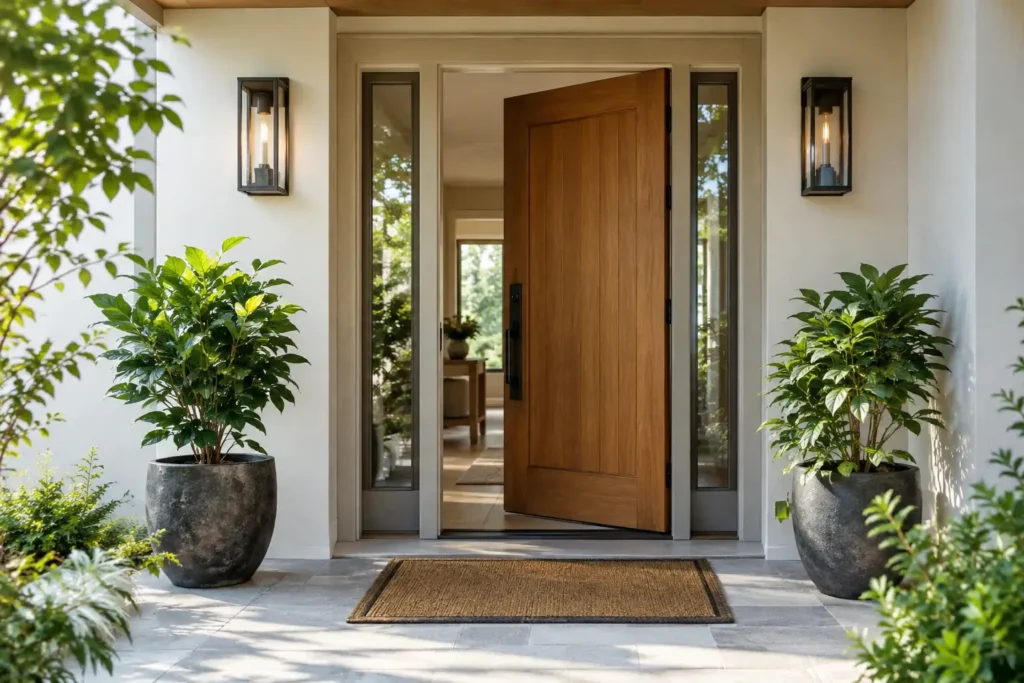
A front door is more than a point of access. It is where residents, visitors, opportunities, and daily activity meet the property. In classical practice, feng shui entrance placement is assessed carefully because the main door is considered the mouth of qi: the primary point through which external qi enters and circulates through a home or business.
That does not mean every attractive doorway creates favorable feng shui, or that a difficult layout is beyond improvement. Effective assessment depends on the property’s external environment, internal circulation, orientation, occupants, and period of construction. A well-positioned entrance should support clear movement and a settled atmosphere, not simply follow a single rule about direction or decoration.
Why Feng Shui Entrance Placement Matters
The entrance establishes the first exchange between a building and its surroundings. From a Form School perspective, the approach to the door, nearby roads, neighboring structures, landforms, and visible obstructions all affect the quality and speed of qi arriving at the property. From a Compass School perspective, the facing direction, sitting direction, and time-related influences of the building add another layer of analysis.
For a residence, the practical concern is whether the entry supports comfort, privacy, family harmony, and the household’s goals. For a commercial property, the main entrance can influence visibility, customer movement, staff morale, and the way business activity is received into the premises. These are different use cases, so the same entrance recommendation should not be applied automatically to both.
The door used most often also matters. A formal front door may be architecturally prominent, while the family enters through a garage or side door every day. In feng shui, the formal main door remains significant, but the actively used entrance can have a strong practical effect on the movement of people and qi. A professional audit considers both rather than treating a floor plan as a purely symbolic exercise.
Start With the External Approach
Before looking at the hallway, look outward from the door. Qi should be able to approach the entrance in a measured, open manner. A path that allows a gentle approach is generally preferred over one that directs fast movement straight at the door.
A long, narrow driveway, a road aiming directly toward the entrance, or a sharp corner from a neighboring building may create aggressive visual and energetic pressure. This does not always require a major renovation. The appropriate response depends on distance, scale, traffic speed, sightlines, and whether the feature is actually dominant from the property.
Likewise, a blocked entrance can reduce both usability and visual welcome. Overgrown plants, overflowing bins, broken lighting, stacked deliveries, or a gate that is difficult to open create a constricted arrival experience. Clearing these issues is a sensible first step, but it is not a substitute for analyzing the wider property configuration.
The ideal external setting is not necessarily wide open. Excessive exposure can feel unsettled, particularly when the door faces a busy street or a large empty expanse. A balanced entrance has enough openness to receive qi while retaining support, definition, and privacy.
Watch for Direct Alignment
One of the most common interior concerns is a straight line from the front door to a rear door, large window, or balcony. When the entry and exit are directly aligned, qi may move through the space too quickly instead of circulating through the home.
The solution is not always to block the view with a large screen. In a small apartment, that can make the entry cramped and dark. Depending on the layout, furniture placement, a rug, a console, lighting, planting, or a modest visual transition may help slow the movement while keeping the space functional. Each remedy should fit the scale of the home and preserve safe circulation.
Direction Is Important, but It Is Not the First Question
Clients often ask which direction a front door should face. There is no universal “best” direction for every person, house, or business. A favorable entrance direction is determined through a structured reading of the property and, where relevant, the occupants’ personal data.
Accurate compass measurement is essential. Measurements taken casually near metal gates, cars, electrical equipment, or reinforced concrete can be unreliable. The building’s actual facing direction must also be distinguished from the direction of a decorative façade, a road, or a side entrance. These details can materially change the analysis.
For established homes, construction or major renovation dates may be needed alongside orientation. Time-based feng shui systems assess how different sectors of a property may perform over particular periods. Personal BaZi information can further clarify whether a household member’s goals and circumstances call for additional emphasis on career, relationships, health, or financial planning.
This is why direction alone should not drive a purchase decision. A property with a seemingly favorable facing direction may still have poor approach conditions, impractical circulation, or other layout concerns. Conversely, a home with a less-than-ideal directional profile may be improved through measured design and usage adjustments.
Internal Entrance Design Should Support Movement
Once qi enters, it needs a clear route into the property. A bright, orderly foyer is generally easier to use and more supportive than a dark passage filled with storage. The goal is not excessive decoration. It is to create a practical transition that feels intentional.
Doors should open fully without hitting piles of shoes, furniture, or fixtures. Lighting should be sufficient for the time residents actually arrive home. If the entrance is narrow, choose proportionate storage and avoid oversized objects that make the area feel compressed. For businesses, ensure that signage, reception placement, and customer pathways are immediately understandable.
Mirrors require particular care. A mirror directly facing the front door is commonly avoided because it can symbolically and visually send incoming qi back out. Yet a mirror positioned on a side wall may be useful in a compact entry where it improves light and visibility. Placement, angle, and scale matter more than a blanket rule.
Color, materials, and décor should also be selected with the building’s overall feng shui requirements in mind. Red is often associated with auspiciousness, but using it indiscriminately does not make an entrance favorable. In many settings, well-maintained finishes, balanced lighting, and an uncluttered threshold provide more value than a dramatic color choice.
When to Seek a Professional Entrance Assessment
An entrance review is especially useful before buying a property, starting a major renovation, moving a business, or changing the main access point. These are decisions where structural choices can be costly to reverse later.
A proper feng shui audit does more than identify a door’s compass sector. It reviews the building’s external forms, floor plan, actual use patterns, directional measurements, and relevant timing factors. Recommendations should be prioritized so clients can distinguish between essential structural considerations, practical improvements, and optional enhancements.
For homeowners, a consultation may also include personal BaZi analysis to align environmental recommendations with the household’s longer-term plans. For commercial clients, the review may extend to customer entry points, reception, executive offices, cash flow areas, and staff circulation. The scope should match the decision being made, not force every property into the same template.
A Better Decision Before You Build or Buy
If you are considering a new door location, begin with the approach rather than the door style. Stand outside at different times of day. Observe where cars, people, noise, wind, and water move. Then walk inside and notice whether the space receives you calmly or pushes you immediately toward another exit, staircase, or obstruction.
Feng shui entrance placement works best when it is integrated early with architecture, interior planning, and the realities of how people use a property. A clear, carefully assessed entrance is not about chasing a formula. It is about giving the home or business a stable, usable point from which the right kind of activity can enter and develop.