
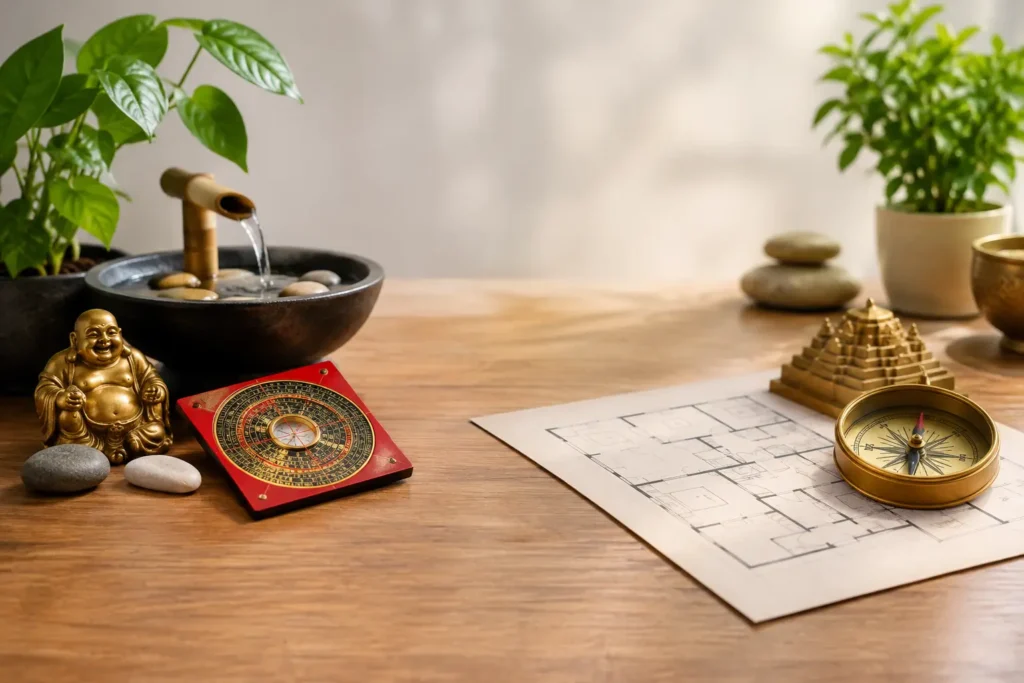
A property can be well designed, properly located, and still feel difficult to live or work in. For clients deciding between feng shui versus vastu shastra, the central question is usually not which tradition is “better.” It is which system fits the property, the decision at hand, and the cultural framework they want to follow with consistency.
Both traditions consider how built environments influence human experience. Both assess orientation, room placement, circulation, and the relationship between people and their surroundings. Yet they come from distinct civilizations, use different technical frameworks, and may lead to very different recommendations for the same home or office.
Feng Shui Versus Vastu Shastra: The Core Difference
Feng shui is a Chinese metaphysical system concerned with the movement and quality of qi within an environment. It evaluates how landforms, external surroundings, building layouts, compass sectors, time cycles, and occupants interact. A professional feng shui assessment is not limited to placing symbolic objects or choosing a lucky color. It is a structured reading of a property in context.
Vastu Shastra is an Indian architectural tradition that considers harmony between a structure, natural forces, directional energies, and the Vastu Purusha Mandala. It places strong attention on the geometry of a site, cardinal directions, the placement of major rooms, and the balance of elemental zones within a building.
The systems share a broad intention: to create an environment that supports health, relationships, stability, and prosperity. However, they do not use the same map, terminology, calculations, or underlying cosmology. Treating one as a version of the other can produce confused decisions and partial remedies.
Different Roots, Different Working Methods
How feng shui reads a property
Classical feng shui begins with the environment around the building. A consultant may examine roads, water features, neighboring structures, slopes, open space, and the approach to the main entrance. These external conditions help determine how qi reaches, gathers, disperses, or becomes disrupted around the property.
The internal assessment then considers the floor plan, the facing direction measured by compass, and the use of each area. Depending on the school and scope of the audit, analysis may include the Eight Mansions system, Flying Stars, the Ba Gua, and annual or longer-term time influences. In more personalized work, the occupants’ BaZi charts can add another layer, helping align a home, workspace, or key room with individual needs.
This means two similar apartments can receive different feng shui advice. Their facing directions may differ, their external surroundings may vary, or their residents may have different personal profiles. Feng shui is therefore often highly site-specific and time-sensitive.
How Vastu Shastra reads a property
Vastu Shastra generally begins with the orientation and shape of the plot or building. The four cardinal directions and their intermediate sectors carry particular significance. The northeast, for example, is frequently treated as a sensitive area for openness and clarity, while other zones may be associated with fire, rest, storage, authority, or stability.
The Vastu Purusha Mandala provides a grid-based framework for organizing space. Practitioners often assess the central area of a home, the placement of the entrance, kitchen, bedrooms, bathrooms, stairs, and heavy or light zones. The ideal form often favors regular geometry, clear directional alignment, and an appropriately balanced center.
Because Vastu is closely tied to architectural planning, it can be especially influential during land selection, new construction, or major renovation. It can also be applied to existing properties, although the practical options may be more limited once structural work is complete.
Direction Matters in Both, But Not in the Same Way
Direction is one of the most visible similarities between the two systems, and one of the most misunderstood.
In Vastu, cardinal directions are foundational. North, south, east, and west, along with their associated sectors, guide the intended placement of functions throughout the building. A Vastu recommendation may focus on whether a kitchen sits in a suitable fire-related zone or whether the main entrance aligns with the desired directional qualities.
In feng shui, direction is also essential, but the analysis is not simply a fixed rule such as “this room must always be in this compass sector.” The property’s facing and sitting directions are measured precisely, then interpreted with the relevant system. In Flying Stars feng shui, for example, a property’s construction period and compass orientation can affect how different sectors are assessed. Annual changes can also influence where activity, renovation, or quiet use is preferable.
This distinction matters when a homeowner encounters conflicting advice online. A directional recommendation from Vastu should not be assumed to apply to a feng shui audit, and vice versa. Each recommendation only makes sense within the method that produced it.
Timing Is a Major Point of Separation
Vastu principles are often applied as enduring spatial guidelines. Once the building orientation and layout are established, the core assessment tends to remain relatively stable, unless the structure or its use changes.
Feng shui can include a stronger timing component. The permanent features of a property still matter, but some methods also track shifting influences by year, month, or larger twenty-year periods. This is particularly relevant for offices, retail spaces, and homes where a previously workable area begins to feel less supportive after a change in use, occupancy, or time cycle.
For business owners, this can make feng shui useful beyond initial layout planning. An office audit may assess the main door, leadership seating, staff work zones, meeting rooms, and revenue-facing areas, then consider current timing when prioritizing adjustments. The objective is not to redesign a workplace every year. It is to make measured decisions about use, activity, and risk-sensitive changes.
Which System Is Better for a Home or Business?
The practical answer depends on your objective.
If you are purchasing land, designing a new house, or working with an architect at an early stage, Vastu may offer a clear directional and planning framework. Its emphasis on plot shape, orientation, room allocation, and central space can be valuable before construction choices become fixed.
If you are evaluating an existing home, condominium, office, or commercial unit, feng shui may provide a more adaptable property-specific assessment. It is particularly useful when external surroundings, building orientation, internal circulation, and the needs of specific occupants all need to be considered together.
For personal decision-making, feng shui can also connect environmental advice with Chinese metaphysical systems such as BaZi. Someone considering a home purchase, office relocation, or major renovation may benefit from assessing both the property itself and the timing of the decision. That does not mean every decision requires a full personal analysis. It means the depth of the consultation should match the significance of the commitment.
Neither approach can replace sound property due diligence. Building condition, legal status, financial capacity, ventilation, daylight, safety, and operational needs remain essential. Metaphysical consultation works best as an additional decision-making framework, not as a reason to overlook practical facts.
Can You Use Feng Shui and Vastu Together?
It is possible to respect both traditions, especially in multicultural households or projects involving different family expectations. The challenge is avoiding a patchwork approach in which isolated rules are collected from videos, social media posts, and multiple practitioners without a clear hierarchy.
Some recommendations may coexist easily. Keeping an entryway clear, improving natural light, reducing clutter, and planning functional circulation are sensible measures in many design traditions. Other recommendations may conflict because the systems assign different meanings to orientation, room placement, or a particular sector.
When conflicts arise, choose one primary framework for the property rather than attempting to satisfy every rule. This produces a more coherent plan and makes it easier to understand why each adjustment is being made. For a client seeking Chinese metaphysical guidance, a structured feng shui audit provides that consistency through measured orientation, site analysis, and recommendations tailored to the property’s actual conditions.
What to Ask Before Booking a Consultation
Before engaging a consultant, define the decision you need help with. Are you choosing between two properties, planning a renovation, setting up a new office, improving a family home, or reviewing a business location? The right scope will differ for each situation.
Ask what information is required, how direction will be measured, whether the consultant considers external landform and surrounding structures, and whether recommendations are permanent, time-sensitive, or both. For a commercial property, clarify whether the assessment includes management seating, staff layout, customer flow, and key operational areas. Clear deliverables matter because they turn broad principles into usable decisions.
A thoughtful assessment should leave you with priorities, not anxiety. Not every imperfection demands construction work, and not every adjustment needs to be expensive. Often, the most effective recommendations concern how a space is used, where activity is concentrated, or what should remain calm and unobstructed.
The most useful choice is not the tradition with the most rules. It is the one applied carefully to your property, your timing, and the decisions you are prepared to make.