
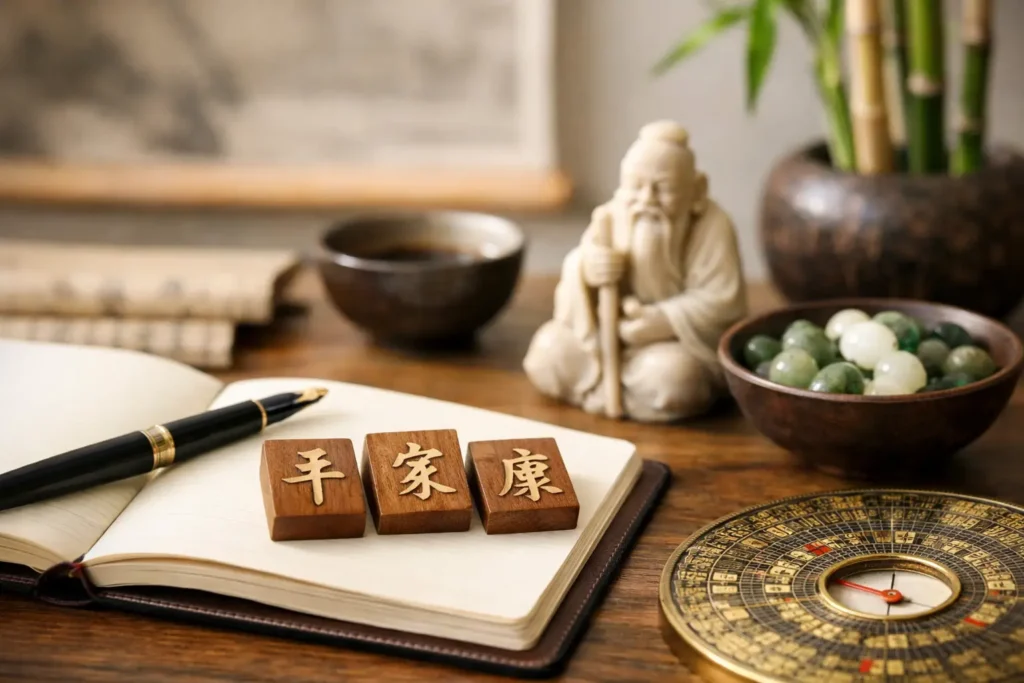
A name can look elegant on paper, sound pleasant in conversation, and still be poorly suited to the person who carries it. That is the central issue in chinese name selection. In a professional metaphysics context, the goal is not simply to choose attractive characters. It is to select a name that aligns with the individual’s BaZi, supports element balance, and remains practical for daily use across family, business, and formal settings.
This is where many people run into confusion. Some focus only on dictionary meanings. Others choose characters based on trend, family preference, or how refined the name appears in writing. Those factors matter, but they are not the full framework. A properly selected Chinese name is usually assessed through several layers at once, including birth data, favorable elements, character structure, sound, usage context, and long-term suitability.
For parents naming a child, adults adopting a Chinese name, or business owners considering a name adjustment, this process deserves more rigor than a quick list of auspicious words.
What chinese name selection actually involves
At a professional level, chinese name selection is not random symbolism. It is a structured evaluation process. The first step is understanding the person’s natal chart through BaZi, also known as Four Pillars of Destiny. This provides the basis for identifying the chart’s strength, weakness, seasonal influence, and favorable elements.
A name is not expected to rewrite destiny. That would be an unrealistic claim. But within traditional Chinese metaphysics, a well-selected name is treated as a supportive input. It can complement the chart by introducing element qualities that are beneficial rather than excessive or draining.
This is why two names with equally positive meanings may not be equally suitable for the same person. A name associated with fire may be helpful for one chart and unhelpful for another. A water-related character may sound graceful, yet create imbalance if the chart already has excessive water influence. The right choice depends on the person, not on the character’s popularity.
Why meaning alone is not enough
Many online name tools prioritize translation-style logic. If a parent wants a name that means intelligence, peace, beauty, or success, the generator returns a list of matching characters. That approach is simple, but it is incomplete.
In Chinese metaphysics, the meaning of a character is only one layer. A name also carries elemental association, stroke composition, phonetic flow, and visual balance. Even cultural tone matters. Some characters may have noble meanings but feel overly old-fashioned in modern use. Others may be fashionable now but lack durability or professional weight later in life.
There is also the issue of overcorrection. Once people learn that names can support favorable elements, they sometimes push too hard in one direction. They may request a name filled with obvious fire or metal references because those elements appear useful in the chart. But an effective name usually needs subtlety. It should support the person without becoming forced, awkward, or narrow in meaning.
A good Chinese name works on two levels at once. It should make metaphysical sense, and it should function well in real life.
The role of BaZi in Chinese name selection
BaZi is often the most important technical foundation in Chinese name selection because it provides context. Without that context, a name is chosen in a vacuum.
The chart reveals more than the presence of the five elements. It shows the seasonal environment of the Day Master, the interactions between stems and branches, and whether the chart benefits more from reinforcement, output, resource, or control. This matters because favorable elements are not selected by simple counting alone.
For example, a person may appear to have very little water in the chart, but that does not automatically mean water should be added through the name. Depending on structure and seasonal strength, introducing more water may weaken the chart rather than help it. Likewise, a chart with strong fire may still benefit from wood in a supportive way, while direct fire addition could become excessive.
This is where experienced interpretation matters. Name selection based on BaZi is not a mechanical exercise. It requires judgment. The consultant must assess what the chart truly needs, then translate that need into suitable character options that are culturally appropriate and practically usable.
What makes a name suitable in daily life
A technically aligned name is only useful if the person can carry it comfortably. That sounds obvious, but it is often overlooked.
A suitable name should be easy enough to pronounce within the family’s language environment. It should not create unnecessary confusion in school, work, or documentation. If the person lives or works internationally, the consultant may also consider how the Romanized form looks and sounds in English-speaking settings.
This does not mean the name should be stripped of cultural depth for convenience. It means the selection should reflect the person’s actual context. A child raised in a bilingual household may need a different naming strategy than someone using the name primarily in a Chinese-speaking environment. An entrepreneur may want a name that conveys credibility and clarity. A newborn’s name may place more emphasis on long-term adaptability and family lineage.
The best names tend to feel balanced rather than exaggerated. They have meaning, but not strain. They are refined, but not overly ornate. They carry support, but still sound natural when spoken every day.
Common mistakes people make
One common mistake is choosing a name because the characters are visually beautiful without checking whether the elemental profile is appropriate. Another is using internet stroke counts from inconsistent systems and assuming the result is authoritative.
People also often rely too heavily on hearsay. A relative may say a certain character is lucky. A friend may recommend a character because it worked well for someone else. But metaphysical suitability is personal. What supports one chart may not support another.
Another issue is mixing goals without priority. Some clients want a name that honors ancestry, matches a sibling pattern, includes a certain sound, carries a modern image, and fixes an elemental imbalance. Those goals are not impossible to combine, but trade-offs are often necessary. Sometimes the most auspicious character does not fit the family naming sequence. Sometimes the most elegant option is less practical in modern use. A disciplined selection process weighs these decisions instead of pretending every requirement can be met perfectly.
When to review or change a name
Not every person needs to change an existing name. If a name has been used for years, carries family significance, and functions well, the decision should be considered carefully. A name change can be meaningful, but it also affects identity, records, and social continuity.
That said, there are valid reasons to review a name. Parents may want a stronger framework before naming a newborn. Adults who were given a name without metaphysical consideration may seek better alignment. Business owners, public-facing professionals, and individuals entering a new life stage may also reassess whether their name still serves its intended role.
The right question is not whether a name is universally lucky. The right question is whether it is appropriate for this person, at this stage, in this context.
What to expect from a professional name selection process
A professional process should be structured, not vague. At minimum, it should begin with accurate birth data and a BaZi assessment. From there, the consultant identifies favorable element direction, filters suitable character options, and considers sound, meaning, and usability.
Clients should also expect explanation. If a name is recommended, there should be a clear reason behind it. Which elements are being supported? Why were certain characters avoided? How does the final option balance metaphysical fit with practical use?
This is where a modern consultancy model adds value. Rather than presenting naming as intuition alone, the process is organized around analysis, selection criteria, and usable recommendations. For clients who want clarity before making a long-term decision, that structure matters.
At East Chen Consultancy, this is the standard clients increasingly expect from traditional services delivered in a professional format.
Choosing a name with more confidence
A Chinese name should do more than sound auspicious. It should be selected with care, supported by proper analysis, and suited to the life the person is actually living.
That is why chinese name selection works best when it is approached as a serious decision rather than a creative exercise alone. The right name is not only meaningful. It is well-timed, well-structured, and personally appropriate.
If you are choosing a name for a child, reviewing your own name, or seeking a better fit for professional use, precision matters. A name stays close to a person for years. It is worth choosing one that can carry that responsibility well.