
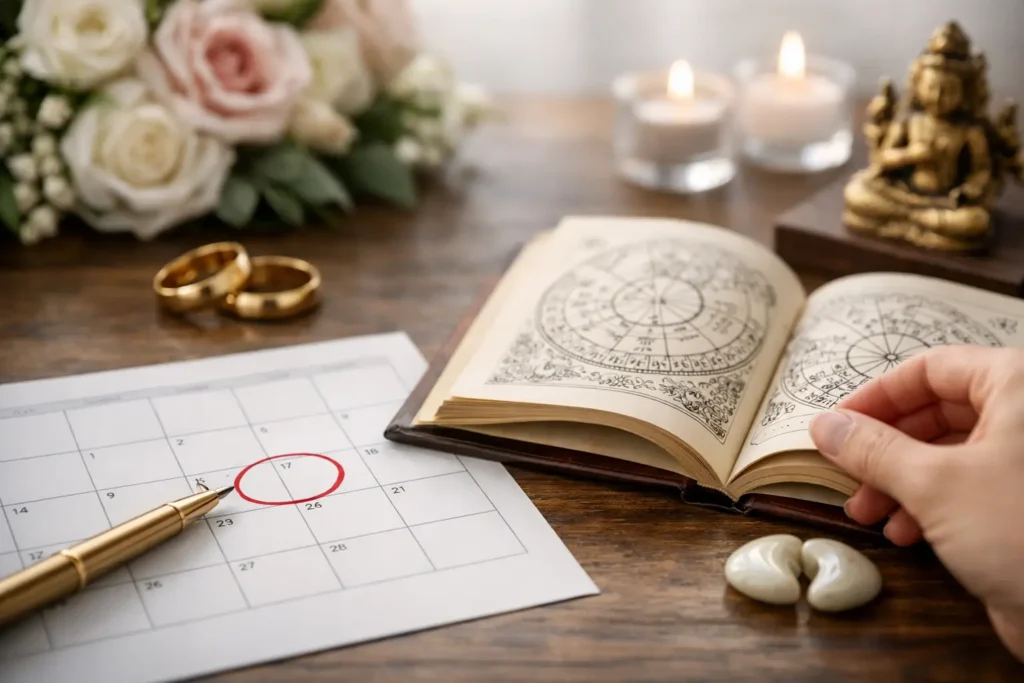
A wedding date is not just a line on a contract or a convenient Saturday on the calendar. In Chinese metaphysics, it is a timing decision that sets the energetic tone for the marriage, the ceremony, and the start of life as a married couple. That is why auspicious wedding date selection is treated as a serious process rather than a quick look at a general lucky date list.
For some couples, the question starts with tradition. For others, it starts with practicality – family availability, venue schedules, travel plans, or cultural expectations. The real value of a professional date selection is that it brings structure to both sides. It respects classical principles while accounting for the couple’s actual circumstances.
What auspicious wedding date selection actually means
Auspicious wedding date selection is the process of identifying dates and times that are supportive for a marriage ceremony based on Chinese metaphysical principles. It is not based on superstition, and it is not a one-size-fits-all recommendation. A date that looks favorable on a generic calendar may still conflict with the bride, groom, or key family members.
In professional practice, the date is assessed against the couple’s birth data, zodiac relationships, elemental balance, and the quality of the day itself. The goal is not simply to find a “lucky day.” The goal is to avoid clashes, reduce unfavorable influences, and choose timing that supports harmony, stability, and a smoother beginning.
This is where many people misunderstand the process. They assume date selection is about chasing the most auspicious day in the month. In reality, it is often about filtering out unsuitable dates first, then identifying the strongest options among the remaining choices.
Why generic lucky dates are often not enough
Generic date lists can be useful as a cultural reference, but they are limited. They usually rank dates based on the general quality of the day without checking whether that day is personally suitable for the couple. That creates a gap between public calendar advice and individualized metaphysical assessment.
A date that is broadly favorable may still carry a clash to one partner’s zodiac sign. Another date may appear average on a public almanac but become highly workable when viewed in the context of the couple’s full birth information. This is why a personalized review matters, especially for a life event with long-term symbolic and emotional weight.
There is also a practical issue. Popular “good dates” fill up fast. If a couple waits too long to verify whether a trendy date is actually compatible, they can end up choosing between an unsuitable date and limited venue options. A structured selection process helps avoid that kind of last-minute compromise.
What is considered in a professional date selection
The strength of a proper consultation lies in the level of detail. The date is not chosen from the calendar alone. It is evaluated through a combination of classical systems and case-specific factors.
The couple’s birth data
Birth date and time are central because marriage timing should be aligned with the individuals entering the union. In many cases, BaZi analysis is used to identify favorable and unfavorable interactions between the selected date and each person’s natal chart. This helps avoid dates that weaken one partner or produce unnecessary conflict energy.
Zodiac clashes and day quality
Chinese date selection also reviews whether a day clashes with the zodiac signs of the couple and, depending on tradition and family preference, the parents. Certain days may be removed immediately because they directly conflict with one of the parties involved. The overall quality of the day also matters. Some days are supportive for marriage-related activities, while others are better suited for different types of events.
The wedding time, not just the wedding day
The ceremony hour can also influence the quality of the event. A strong date can be undermined by a poorly matched time slot, particularly if it creates avoidable clashes or weakens the overall configuration. For couples planning tea ceremonies, solemnizations, and banquet events across the same day, timing may need to be layered carefully rather than treated as a single block.
Real-world constraints
A precise recommendation still has to work in real life. Venue availability, religious requirements, legal registration timing, travel logistics, and family scheduling all matter. A professional consultant does not ignore these constraints. The objective is to identify the best available dates within the client’s planning window, not to recommend an idealized date that is impossible to use.
Auspicious wedding date selection and family expectations
For many couples, the technical side of date selection is only one part of the decision. The emotional and cultural side can be just as important. Parents may expect a traditional process. Intercultural couples may want to honor Chinese customs without feeling overwhelmed by rules. Some clients simply want confidence that they have handled this milestone with care.
This is where a clear consultation framework helps. Instead of vague advice or contradictory opinions from multiple relatives, the couple receives a defined set of recommended dates with rationale. That makes conversations easier. It turns the process from family debate into informed planning.
There can also be trade-offs. A highly favorable date might fall on a weekday, which affects guest attendance. A weekend option may be slightly less ideal metaphysically but far more practical for the event scale. In cases like this, the best answer is not always the most theoretically perfect date. It is the strongest viable date that supports both the marriage and the event execution.
When to start the date selection process
Earlier is usually better. Couples booking venues 9 to 18 months in advance should not leave date selection until the final stage. If timing matters to you, it should be addressed before major contracts are signed.
A good window is to begin once the couple has a realistic wedding period in mind. That may be a season, a quarter, or a set of preferred months. From there, suitable dates can be screened and narrowed down before venue discussions are finalized.
This timing is especially important for couples planning around peak wedding periods, destination events, or multiple ceremony components. The more moving parts involved, the more useful it is to have a vetted shortlist rather than a single date chosen in isolation.
Common misconceptions about selecting a wedding date
One common misconception is that there is only one correct date for a couple. In practice, there are often several acceptable dates within a range, with some stronger than others. A consultation typically identifies the best options rather than presenting a single rigid answer.
Another misconception is that date selection guarantees a perfect marriage. It does not. Chinese metaphysics is a tool for better timing, not a replacement for compatibility, communication, and shared values. Choosing a suitable date supports the start of the marriage, but it does not remove the need for mutual effort.
A third misconception is that if a couple has already booked a date, there is no point in consulting. That depends on the situation. Sometimes the selected date can still be reviewed, and favorable ceremony times or procedural adjustments can be recommended to improve the outcome. Not every case requires starting from scratch.
Who benefits most from a personalized consultation
Couples with strong cultural ties often see date selection as a non-negotiable part of the wedding process. But the service is also useful for those who prefer structured decision-making. If you want more than a generic lucky date, a personalized consultation provides a method, not just an opinion.
It is particularly relevant for couples managing family input, cross-border planning, limited venue options, or uncertainty about which traditions to prioritize. A clear recommendation reduces confusion and gives the planning process a stronger foundation.
For clients who value professional handling, this is where a firm such as East Chen Consultancy stands apart. The work is presented as a defined advisory service, with a practical focus on accuracy, usability, and decision support rather than vague spiritual language.
A wedding marks the beginning of a shared chapter. Choosing the date with care does not make the marriage for you, but it does show respect for the timing of that beginning – and for many couples, that is exactly the right place to start.