
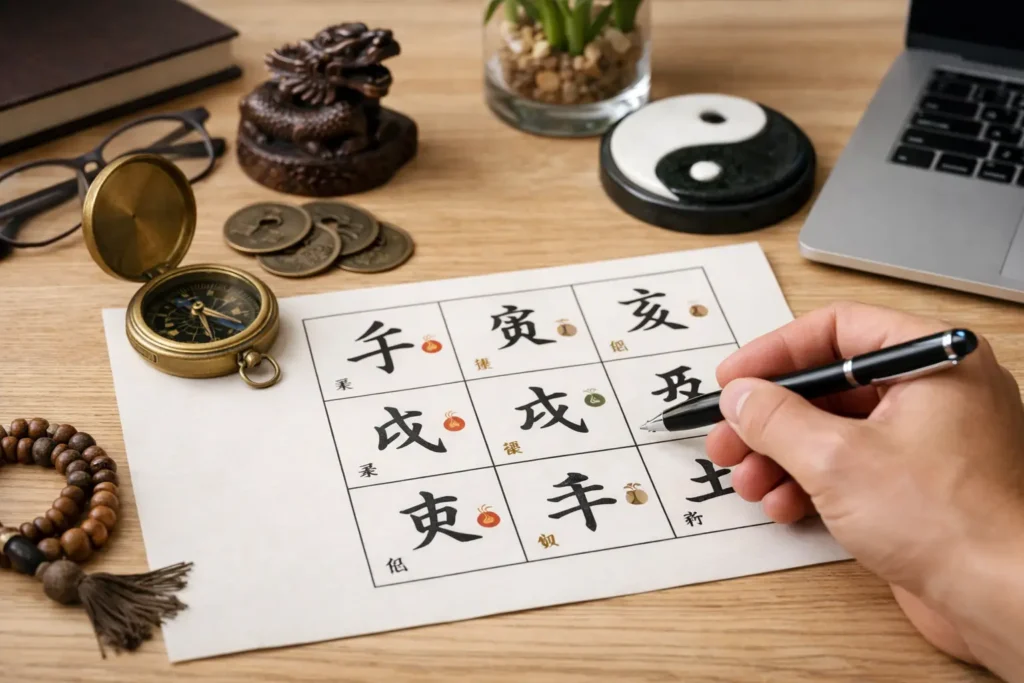
A BaZi chart is not a personality quiz and it is not a prediction machine. It is a structured record of the energy present at the moment of birth, interpreted through classical Chinese metaphysics. For those who want to learn BaZi for beginners, the best starting point is to understand the chart’s language before trying to forecast career, wealth, relationships, or timing.
BaZi, also called the Four Pillars of Destiny, can offer a practical framework for recognizing strengths, pressure points, recurring patterns, and favorable periods for action. Its value lies in informed interpretation. A chart should be read with context, care, and an understanding that personal choices, environment, and timing all matter.
What BaZi Means and What It Can Help You Assess
BaZi translates to “Eight Characters.” These eight characters come from the Heavenly Stems and Earthly Branches assigned to your year, month, day, and hour of birth. Together, they form four pillars: the Year Pillar, Month Pillar, Day Pillar, and Hour Pillar.
Each pillar carries information, but they do not all speak about the same area of life. The Year Pillar is often associated with ancestry, early environment, social circles, and the wider world. The Month Pillar is central to career dynamics, upbringing, seasonal energy, and the chart’s overall strength. The Day Pillar represents the individual, including the Day Master and relationship palace. The Hour Pillar can relate to future aspirations, children, projects, legacy, and private ambitions.
A professional BaZi reading considers how these pillars work together rather than assigning a fixed meaning to one animal sign. Knowing that you were born in the Year of the Dragon, for example, is culturally familiar but only reveals a small portion of a complete BaZi analysis.
Learn BaZi for Beginners by Starting With the Day Master
The Day Master is the Heavenly Stem of the day you were born. It represents the core self within the chart. There are ten possible Day Masters, formed by the five elements in yin and yang expressions: Wood, Fire, Earth, Metal, and Water.
A Yang Wood Day Master is often compared to a tall tree, while Yin Wood may resemble a vine or flower. Yang Fire is like the sun, and Yin Fire is like a candle or refined light. These images are useful teaching tools, but they are not complete interpretations. A person’s behavior, opportunities, and challenges depend on whether their Day Master is supported, weakened, controlled, or transformed by the rest of the chart.
This is where many beginners make an avoidable mistake. They read a short description of their Day Master and assume it defines their character permanently. BaZi is relational. A Metal Day Master with strong Earth support may function very differently from a Metal Day Master surrounded by Fire and weak roots. The chart must be assessed as a system.
The Five Elements Are Relationships, Not Labels
The Five Elements describe cycles of generation and control. Wood feeds Fire. Fire creates Earth. Earth produces Metal. Metal enriches Water. Water nourishes Wood. In the controlling cycle, Wood controls Earth, Earth controls Water, Water controls Fire, Fire controls Metal, and Metal controls Wood.
For beginners, these cycles explain why an element is not automatically “good” or “bad.” Water may be helpful in one chart and excessive in another. Fire can indicate visibility, expression, or pressure depending on its relationship to the Day Master and the season of birth.
The most useful question is not, “Do I have enough of an element?” Instead, ask, “What role does this element play in my chart, and does it support balance?” This distinction prevents simplistic remedies and leads to more accurate analysis.
Understand the Importance of Season
The Month Branch is especially significant because it reflects the season in which a person was born. A Wood Day Master born in spring may have strong seasonal support. The same Wood Day Master born in autumn, when Metal energy is prominent, may require a different analysis.
Seasonal strength affects how the elements behave. A chart with apparent Fire may still be cold if it is born in winter and lacks sufficient support. A chart containing Water may still need more Water under certain conditions. This is why counting elements alone is not a reliable method of reading BaZi.
A structured analysis looks at seasonal Qi, visible stems, hidden stems within branches, combinations, clashes, roots, and the interactions between pillars. Beginners do not need to calculate every layer immediately, but they should know that a proper reading extends beyond a colorful online chart generator.
The Ten Gods Give the Chart Practical Context
Once you understand the Day Master, the next major concept is the Ten Gods. Despite the name, these are not deities. They are relationship categories that describe how the other elements relate to your Day Master.
For example, the Resource star can relate to learning, support, qualifications, and guidance. Output can relate to communication, creativity, delivery, and visibility. Wealth may relate to financial management, commercial opportunity, and responsibility. Officer energy can refer to structure, career expectations, authority, rules, and accountability. Companion energy often relates to peers, competition, collaboration, and self-direction.
The Ten Gods are valuable because they translate elemental relationships into real-life themes. However, no single star should be read in isolation. Wealth energy does not guarantee financial success, and Officer energy does not guarantee a senior title. The actual outcome depends on chart structure, favorable and unfavorable elements, luck cycles, choices, and the environment in which a person operates.
Use Your Birth Data Carefully
Accurate birth data is essential. You will need your date of birth, birth time, and place of birth. The hour of birth matters because it determines the Hour Pillar, and it may also influence whether adjustments for local solar time are necessary.
If your birth time is uncertain, do not treat an automatically generated chart as final. A difference of one or two hours can change the Hour Pillar. In some cases, a qualified practitioner may use life events to help verify a likely birth hour, but this requires careful consultation rather than guesswork.
It is also wise to use a calculator that recognizes the solar calendar system used in BaZi. The BaZi year does not always begin on January 1, and the month pillars follow solar terms rather than standard calendar months. Someone born close to a solar term may need their chart checked with particular precision.
A Practical Study Sequence for Beginners
BaZi has depth, and trying to learn every advanced technique at once usually leads to confusion. A measured sequence produces better results:
- Learn the ten Heavenly Stems and twelve Earthly Branches, including their elemental qualities and yin-yang polarity.
- Identify your Day Master and study the productive and controlling relationships of the Five Elements.
- Learn how the Month Branch establishes seasonal strength and why element counting is insufficient.
- Study the Ten Gods as functional relationships, not as fixed promises.
- Begin reviewing combinations, clashes, harms, and punishments only after you can assess the basic chart balance.
- Move to luck pillars and annual influences after building confidence with the natal chart.
Keep a study notebook. When reviewing charts, write down what you observe before reading an interpretation. Note the season, Day Master, visible elements, repeated branches, and obvious interactions. Over time, compare those observations with real-life circumstances. This develops disciplined pattern recognition rather than reliance on memorized keywords.
Common Errors That Limit a Beginner’s Progress
The most common error is treating BaZi as fatalistic. A chart may show tendencies, timing, and areas that require greater awareness, but it does not remove personal agency. A challenging period may call for stronger planning, more conservative financial decisions, clearer communication, or a shift in priorities. It does not mean that every outcome is predetermined.
Another mistake is applying generic element advice without understanding chart structure. Wearing a certain color, changing a business logo, or selecting a career solely because an element appears favorable can be overly simplistic. Personal BaZi works best when combined with real-world facts, such as financial readiness, skills, market conditions, health, and family responsibilities.
Finally, avoid reading isolated clashes as automatic disasters. A clash may indicate movement, change, tension, transition, or a need to adjust. Its practical effect depends on which pillars are involved, whether the affected element is useful, and what timing cycle activates it.
When Professional Guidance Makes Sense
Self-study is valuable for building literacy, especially if you want to understand the terminology used in a personal consultation. Yet some situations benefit from a full, structured assessment. These include career transitions, business partnerships, property decisions, marriage timing, major investments, and periods that appear to bring repeated uncertainty or change.
A professional consultation should clarify the chart’s useful elements, key structural themes, major luck cycles, and practical areas for attention. It should not rely on fear-based statements or vague promises. East Chen Consultancy approaches BaZi as a decision-support framework, translating traditional chart analysis into clear discussion points relevant to personal and professional planning.
Learning BaZi begins with patience. Read your chart as a map of relationships and timing, not a verdict on your future. The more carefully you study its foundations, the more useful the system becomes when you need to make decisions with greater perspective.