
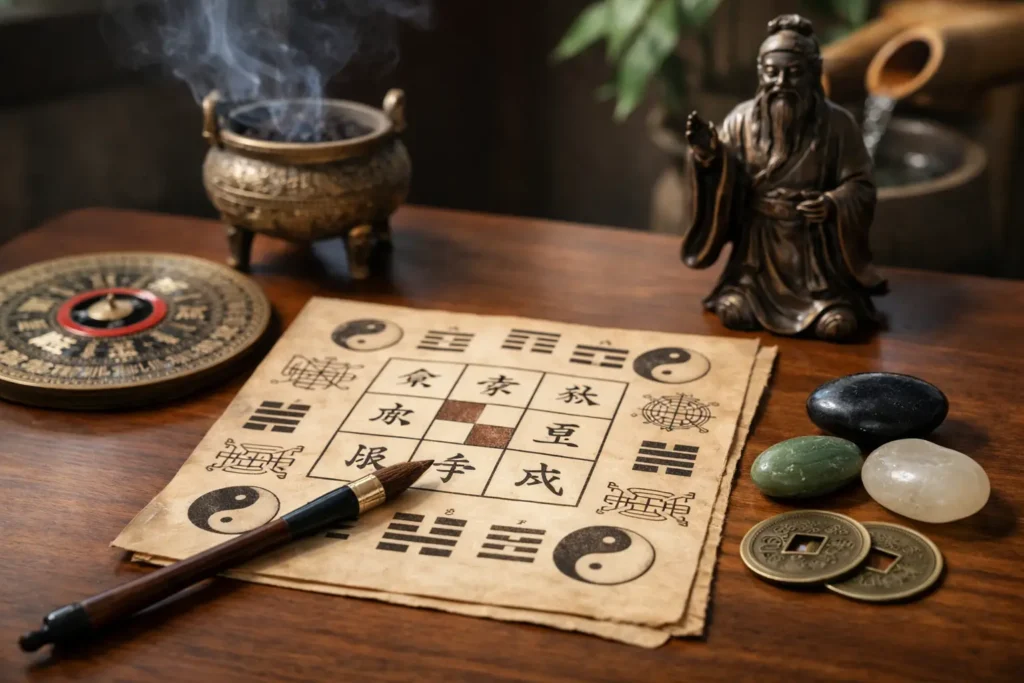
Most people first ask what is qi men dun jia when they are facing a decision that does not feel minor – a business move, a property matter, a career change, or a relationship question where timing matters as much as effort. That is where Qi Men Dun Jia stands apart. It is not simply about personality, and it is not only about space. It is a classical Chinese metaphysics system used to assess timing, direction, strategy, and situational advantage.
In practical terms, Qi Men Dun Jia helps answer questions such as when to act, which option has stronger support, what hidden dynamics may be operating, and how to position yourself more effectively. For clients who want a structured way to approach important decisions, it offers a strategic framework rather than vague inspiration.
What is Qi Men Dun Jia?
Qi Men Dun Jia is one of the higher-level systems in Chinese metaphysics, historically associated with strategy, planning, military decision-making, and the reading of dynamic conditions. Today, it is commonly applied to modern concerns such as business decisions, negotiations, career direction, travel, partnerships, property matters, and date selection.
The name is often translated in different ways, but the key point is not the literal wording. What matters is the function. Qi Men Dun Jia maps a moment in time into a structured chart. That chart is then analyzed to understand the quality of the situation, the roles of the people involved, the available opportunities, and the likely obstacles.
Unlike systems that focus mainly on a person’s fixed life blueprint, Qi Men Dun Jia is highly situational. It is especially useful when the question is specific. If someone asks, “Is this the right week to sign?” or “Should I pursue this deal or wait?” or “Why is this project stalling despite strong preparation?” this is the kind of system built to examine that moment.
How Qi Men Dun Jia works in practice
A Qi Men Dun Jia analysis is based on a chart created from a particular date and time. That chart contains a number of components, including palaces, doors, stars, deities, stems, and directional relationships. To a newcomer, that language can sound technical. In consultation, however, the value is not in memorizing terms. The value is in interpretation.
An experienced practitioner reads the chart as a strategic landscape. One sector may show stronger support for communication and negotiation. Another may indicate delay, conflict, hidden issues, or weak execution. A chart can also reveal whether a person is acting from a position of strength or trying to push forward against unfavorable timing.
This is why Qi Men Dun Jia is often compared to strategic forecasting rather than fortune telling. It does not remove free will. It shows conditions. A favorable chart does not guarantee success without good decisions, and a difficult chart does not mean failure is fixed. It means the environment around the decision has a certain structure, and that structure should be respected.
What is qi men dun jia used for today?
In a modern consulting context, Qi Men Dun Jia is used because many decisions are time-sensitive. People do not always need a broad life reading. Sometimes they need precision.
For business owners, it can support launch timing, negotiations, team issues, partnership concerns, and strategic planning. For homeowners or property buyers, it may be used alongside other metaphysics tools to evaluate timing around purchases, moves, renovations, or key transactions. For individuals, it can help with job changes, relationship questions, important travel, and the handling of personal obstacles.
It is also commonly used for date selection. That does not mean choosing a date based on one factor alone. A proper selection process considers purpose. The right date for a wedding is not the same as the right date for signing a contract or starting renovations. Qi Men Dun Jia adds another layer of strategic timing, especially when the goal is outcome-oriented.
How it differs from BaZi and Feng Shui
One of the most common points of confusion is how Qi Men Dun Jia differs from BaZi or Feng Shui. They are related within Chinese metaphysics, but they do different jobs.
BaZi focuses on a person’s birth data to understand innate traits, life cycles, strengths, weaknesses, and longer-term patterns. It is useful for understanding potential, personal timing, career structure, relationship tendencies, and major phases of life.
Feng Shui focuses on the environment. It examines how a home, office, or property layout interacts with time and occupants. It is used to improve spatial support for health, wealth, relationships, and performance.
Qi Men Dun Jia, by contrast, is often the system used when the question is immediate and strategic. It looks at the active moment and helps determine the best course of action within current conditions. In many cases, these systems work best together. A person may have strong BaZi potential, but poor timing can still create friction. A property may have good Feng Shui, but a poorly chosen date can still complicate execution.
Why accuracy depends on the question
Qi Men Dun Jia is powerful, but it is not a shortcut for careless decision-making. The quality of the reading depends heavily on the quality of the question. A broad question such as “Will everything go well this year?” is less useful than “Is this quarter favorable for opening a second branch?” or “What is blocking progress in this negotiation?”
Specific questions allow the chart to be read with greater clarity. That is one reason professional consultation matters. A structured session helps define what is actually being asked, what outcome matters most, and what level of timing or strategic detail is needed.
There is also a difference between reading possibilities and promising outcomes. A responsible practitioner will explain both strengths and constraints. Some charts show strong potential but require speed and precision. Others suggest patience, discretion, or a change of approach. The advice is rarely one-size-fits-all.
What a consultation can realistically provide
A good Qi Men Dun Jia consultation should leave you with direction, not confusion. In a professional setting, the goal is not to overwhelm you with technical vocabulary. It is to translate the chart into actionable guidance.
That may include identifying the strongest timing window, evaluating competing options, understanding hidden risks, clarifying the role of key people, or advising whether to proceed, delay, reposition, or avoid. For some clients, the most valuable outcome is confirmation. For others, it is discovering that the original plan is sound but the timing or method needs adjustment.
It is equally important to recognize limits. Qi Men Dun Jia is not meant to replace legal, financial, medical, or operational expertise. It works best as a decision-support framework. When used properly, it can sharpen judgment and improve timing. When treated as a substitute for practical responsibility, it is being misused.
What is qi men dun jia really telling you?
At its core, Qi Men Dun Jia tells you whether your current move is aligned with the moment. That sounds simple, but in real life it is often the missing piece. Many people have ability, resources, and a solid plan, yet they still meet unusual resistance. Others move at the right moment and gain traction with less force.
This is why the system remains relevant. It does not ask you to abandon logic. It asks you to factor in timing and strategic positioning with the same seriousness you would give to budget, market conditions, or personal readiness.
For clients seeking practical Chinese metaphysics rather than abstract theory, that distinction matters. A modern consultancy such as East Chen Consultancy presents Qi Men Dun Jia not as mysticism for its own sake, but as a structured advisory tool for real decisions with real consequences.
If you are considering Qi Men Dun Jia, the best place to start is not with memorizing chart components. Start with the decision in front of you. The clearer the question, the more useful the guidance can become – and sometimes that clarity is what changes the result.