
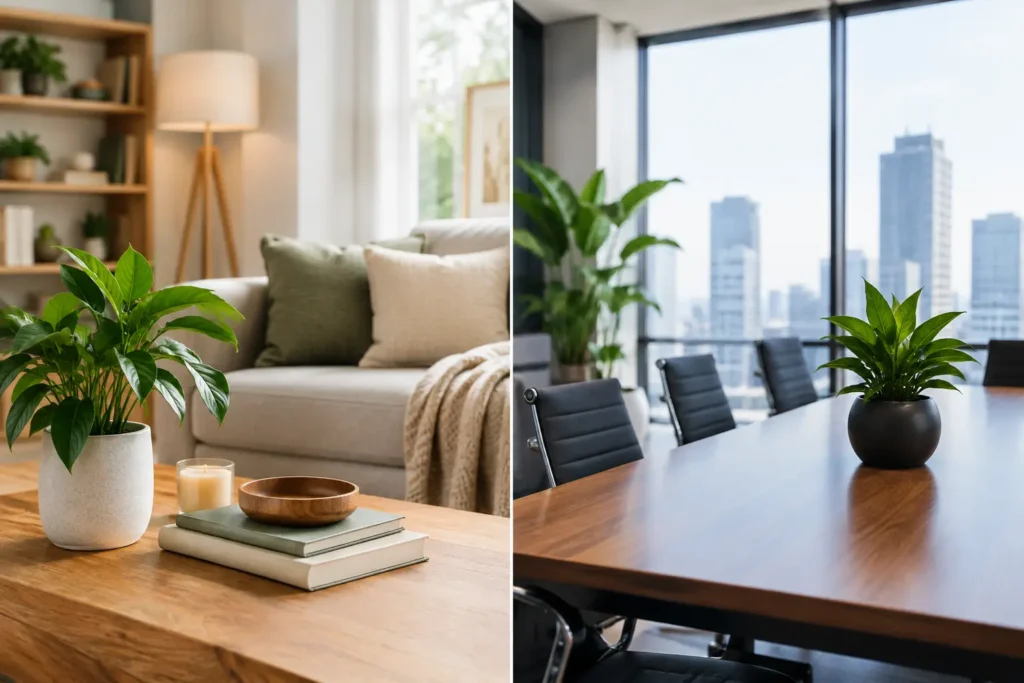
A front door can welcome a family home into a calmer daily rhythm, but the same entrance in a retail store may need to do something more immediate: support visibility, customer movement, and commercial activity. That distinction sits at the center of residential versus commercial feng shui. Both work with the relationship between people, space, and environmental influences, yet they are assessed according to very different outcomes.
A home is a private environment shaped by rest, relationships, health, and the long-term needs of its occupants. A commercial property is an operating environment, where the layout must support leadership, staff coordination, customer confidence, financial activity, and the practical demands of the business. Applying the same recommendations to both can overlook the real purpose of the property.
Residential Versus Commercial Feng Shui: The Core Difference
Classical feng shui evaluates how external and internal forms influence a property. This includes surrounding roads, neighboring structures, landform, building orientation, entrances, room placement, circulation, and the quality of qi within the space. These principles apply whether the property is a condominium, landed home, office, clinic, restaurant, or shop.
The difference is in the brief. A residential audit begins with the people who live there. Their household structure, life stage, priorities, and, where relevant, BaZi profiles may shape the analysis. A family with young children may prioritize bedroom placement, study areas, household harmony, and rest. A couple purchasing their first home may be more focused on stability, relationship dynamics, and future planning. The recommendations should be practical for the way the residents actually live.
Commercial feng shui begins with the business model and operational reality. A professional services office, for example, has different requirements from a high-volume retail outlet. One may need to reinforce authority, focused decision-making, client trust, and staff productivity. The other may depend more heavily on frontage, foot traffic, visual access, customer flow, and the position of transaction points. The property is not assessed as a generic workplace. It is assessed as a working asset with specific commercial objectives.
What a Residential Feng Shui Audit Prioritizes
A residential audit considers the home as a long-term container for personal life. The main door, living areas, bedrooms, kitchen, study, and bathrooms are reviewed in relation to the property’s orientation and layout. The external environment matters as much as the floor plan. A busy road, an aggressive neighboring structure, a narrow approach, or an obstructed entrance can affect how the home receives and holds qi.
Bedrooms receive particular attention because they are spaces of rest and recovery. A suitable bed position should provide support and reduce avoidable disturbance, while still fitting the room’s actual dimensions and the resident’s needs. A recommendation that looks correct in theory but leaves no usable circulation space is not a useful recommendation.
The kitchen is also significant. It supports nourishment, routine, and household management, so its location and relationship with other sectors of the home are examined carefully. In modern apartments, structural constraints often limit major changes. A professional consultation therefore distinguishes between what should be addressed through renovation, what can be improved through placement or usage, and what simply needs to be managed with awareness.
Personalization is often more relevant in residential work. BaZi can provide an additional layer of insight into an individual’s favorable elements, personal tendencies, and timing. It does not replace a property assessment. Rather, it can help refine decisions such as room allocation, work-from-home positioning, or the suitability of a home for a particular household at a particular stage of life.
What a Commercial Feng Shui Audit Prioritizes
Commercial feng shui is closely connected to function. A well-designed office may still underperform if key decision-makers are seated in exposed positions, if staff circulation is disruptive, or if the reception area creates confusion rather than confidence. Likewise, a shop with attractive interior design may lose practical advantage if its entry, display arrangement, or cashier position works against natural customer movement.
The building’s location and external environment are usually examined first. For a client-facing business, the approach to the unit, road alignment, neighboring tenants, visibility, parking access, and entrance condition may influence the quality and pace of incoming activity. For an office, the surrounding environment may affect stability, concentration, and the ability to retain talent or clients over time.
Inside, the audit focuses on functional zones. Reception, leadership offices, workstations, meeting rooms, sales areas, cashier counters, storage, and pantry facilities each serve a different purpose. The managing director’s seat is not evaluated in the same way as a customer waiting area, and a finance department may require different considerations from a creative team.
A commercially useful recommendation must respect workflow. Moving a cashier counter may be possible in one store and impractical in another because of wiring, inventory controls, lease restrictions, or customer service requirements. In these cases, the consultant’s role is not to impose an idealized layout. It is to identify the strongest available solution within the business’s operational limits.
Timing Has Different Weight in Each Setting
Timing matters in both residential and commercial decisions, but the decisions themselves are different. Homeowners may seek favorable dates for moving in, renovation, marriage, or the start of a new household chapter. The emphasis is usually on personal alignment and the orderly beginning of life events.
For businesses, timing may relate to opening a new outlet, relocating an office, launching a major initiative, signing a lease, beginning renovations, or activating a new leadership structure. Qi Men Dun Jia consultation and auspicious date selection may be relevant when a business owner is choosing between strategic options or preparing for a significant transition.
Timing should not be used as a substitute for commercial diligence. A favorable opening date cannot correct an unsustainable lease, unclear market positioning, or weak cash-flow planning. However, when a sound business decision has already been made, selecting an appropriate time can provide an additional layer of structure and intention around execution.
Why One-Size-Fits-All Advice Falls Short
Many common feng shui tips are presented without context: place an object in a corner, add a water feature, use a particular color, or hang a mirror near an entrance. These suggestions may be harmless in some cases, but they are not a substitute for an audit. A feature that is beneficial in one property may be inappropriate in another because of orientation, sector influence, the surrounding forms, or the people using the space.
This is especially relevant for commercial properties. A water feature, for example, may create a visual impression that suits a hospitality setting but be unsuitable for an office where maintenance, noise, safety, or the business’s operating character make it impractical. Feng shui should improve the function and clarity of a space, not add decorative complications.
The same principle applies to renovation. Structural changes can be valuable when they correct a major layout issue, but not every concern requires construction. A careful audit prioritizes actions according to impact, budget, feasibility, and the length of time the client expects to occupy the property. A tenant on a two-year office lease needs a different strategy from an owner renovating a family home for the next decade.
Choosing the Right Type of Consultation
A residential consultation is appropriate when buying a home, moving into a new property, planning a renovation, managing persistent discomfort in the household, or allocating rooms for family members. It can also be valuable when a home must support both living and remote work, especially when boundaries between rest and professional responsibilities have become unclear.
A commercial consultation is appropriate before signing for a new office, retail unit, clinic, restaurant, or warehouse, as well as before a relocation, expansion, or major fit-out. Early involvement is usually more efficient because important decisions about entrances, room allocation, counter placement, and leadership seating can be considered before construction begins.
For either type of audit, accurate information leads to better advice. Floor plans, compass readings, site photographs, the property’s construction or move-in history where available, and a clear statement of priorities help establish the right scope. Commercial clients should also be prepared to explain how customers, staff, goods, and decisions move through the business.
East Chen Consultancy approaches these audits as structured property advisory work rather than generic decoration advice. The objective is to translate classical feng shui principles into recommendations that can be understood, evaluated, and applied in a modern home or business environment.
The most useful question is not whether a property needs feng shui in the abstract. It is whether the space is supporting the people and outcomes it was meant to serve. When the answer is approached with clear goals, accurate assessment, and practical follow-through, the property becomes easier to use with purpose.